
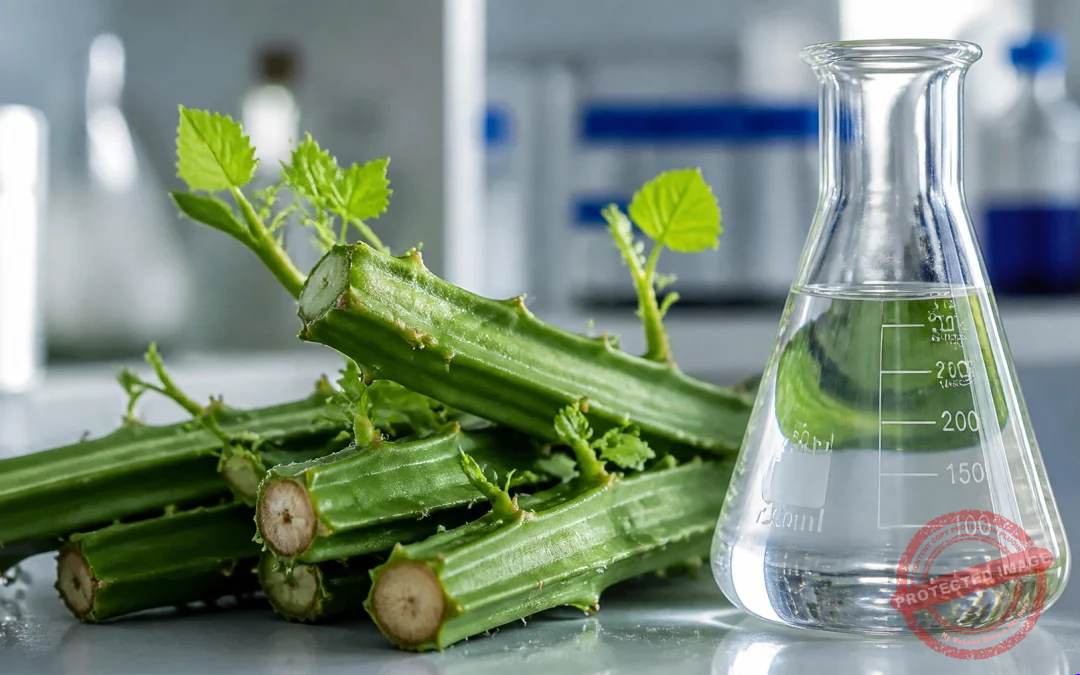
Cissus quadrangularis (CQ), a perennial plant belonging to the Vitaceae family, has long been a subject of rigorous scientific inquiry due to its unique chemical profile and its historical classification as a "bone setter" in traditional botanical systems. As of 2026, research into the pharmacological applications of its extracts has reached a new level of precision, particularly regarding the optimization of solubility and the enhancement of bone mineral density markers.
For researchers and laboratory technicians, the challenge has often been the extraction and stabilization of the plant's hydrophobic constituents. This technical guide explores the current scientific landscape of CQ, focusing on the latest research findings from 2024–2026 and the critical role that high-purity organic solvents, such as Dimethyl Sulfoxide (DMSO), play in its analytical and experimental applications.
Chemical Composition and Biological Markers
The efficacy of Cissus quadrangularis in experimental models is attributed to a complex matrix of phytochemicals. Recent chromatographic analyses have identified several key categories of active compounds:
- Ketosteroids: These are the most studied components of CQ, believed to be responsible for its influence on the anabolic-androgenic pathways involved in bone tissue regeneration.
- Triterpenoids and Stilbenes: Compounds like resveratrol and quadrangularin A have been isolated, exhibiting significant antioxidant and anti-inflammatory properties in laboratory assays.
- Flavonoids: Quercetin and rutin are present in high concentrations, contributing to the stabilization of collagen fibers and the reduction of oxidative stress within joint tissues.

Mechanism of Action: Bone Mineral Density and the OPG/RANKL Pathway
Research conducted between 2024 and 2026 has refined our understanding of how CQ extracts interact with skeletal biology. One of the most significant areas of focus is the modulation of the OPG/RANKL axis.
In bone remodeling, Osteoprotegerin (OPG) and the Receptor Activator of Nuclear Factor Kappa-B Ligand (RANKL) must exist in a delicate balance. RANKL promotes bone resorption (breakdown), while OPG acts as a decoy receptor to inhibit this process. Peer-reviewed studies in 2025 have demonstrated that purified CQ extracts can effectively up-regulate OPG expression while down-regulating RANKL in osteoblast cell lines.
Furthermore, CQ has been shown to enhance osteoblast differentiation by increasing the expression of Runx2, a master transcription factor essential for bone formation. By stimulating the synthesis of alkaline phosphatase (ALP) and Type I collagen, CQ extracts facilitate the mineralization of the extracellular matrix, which is a critical step in the management of osteoporotic models and fracture recovery research.
The Role of DMSO in Solubility and Absorption Research
A significant hurdle in the study of Cissus quadrangularis is the limited solubility of its primary ketosteroids in aqueous environments. To overcome this, researchers utilize 99.9% Pure Dimethyl Sulfoxide (DMSO) as an analytical reagent and excipient.
DMSO is a highly polar, aprotic organic solvent that excels at dissolving both polar and non-polar compounds. In 2024–2026 experimental protocols, DMSO is frequently employed to:
- Improve Solubility: By dissolving concentrated CQ extracts into a stable liquid state, DMSO ensures that the bioactive constituents are evenly distributed for in vitro testing.
- Enhance Permeability: In topical and transdermal studies, DMSO’s unique chemical properties allow it to penetrate biological membranes, carrying the dissolved CQ extracts into deeper tissue layers. This synergy is particularly relevant in arthritis management research, where localized delivery to the joint capsule is paramount.
- Stabilize Extracts: DMSO helps preserve the integrity of sensitive phytochemicals, preventing degradation during long-term laboratory storage.

2024–2026 Research Highlights: Arthritis and Fracture Healing
Recent literature has highlighted several breakthrough findings regarding the use of Cissus Q in specialized applications:
- Synergistic Formulations: A 2025 study explored the combination of CQ with self-emulsifying drug delivery systems (SEDDS). Researchers found that by utilizing organic solvents to create nano-emulsions, the oral bioavailability of CQ’s ketosteroids was increased by approximately 76% compared to standard powder forms.
- Inflammatory Modulation: Research published in early 2026 indicated that CQ extracts could suppress pro-inflammatory cytokines, specifically IL-6 and TNF-α, in synovial fluid models. This suggests a powerful role for CQ in mitigating the degradative processes associated with chronic joint inflammation.
- Accelerated Fracture Recovery: Clinical observations in animal models showed that the application of CQ extracts resulted in a faster formation of the fibrocartilaginous callus, significantly shortening the time required for bone union.
Technical Specifications for Analytical Reagents
When sourcing materials for research, such as DMSO used for dissolving Cissus quadrangularis extracts, quality and purity are non-negotiable. DMSO supplied by DMSO.co.za is a 99.9% pure analytical reagent derived from wood-pulp (Lignin).
Key Indicators of Purity:
- Freezing Point: DMSO has a definitive freezing point of 18.5°C. If the solvent does not crystallize at this temperature, it indicates the presence of impurities or water content.
- Storage Requirements: Due to its high reactivity as a solvent, DMSO must be stored strictly in HDPE (High-Density Polyethylene) or borosilicate glass containers. It will leach phthalates and other toxins from standard plastics (like PET).
- Origin: Our DMSO is sourced from organic Lignin, ensuring a pharmaceutical-grade standard suitable for high-level laboratory and industrial applications.

Conclusion
The evolution of Cissus quadrangularis research through 2026 confirms its status as a cornerstone of botanical science in bone and joint health. The integration of high-purity solvents like DMSO has allowed for a deeper exploration of its pharmacological potential, particularly in the realms of solubility enhancement and systemic absorption. Whether for fracture healing models or the management of arthritic degradation in experimental settings, CQ remains a primary focus of modern osteological study.
For those requiring high-purity materials for their own research or industrial applications, we offer both Cissus Q and 99.9% pure DMSO for nationwide delivery across South Africa.
References
- Thangaraj, S., et al. (2024). Phytopharmacological Review of Cissus quadrangularis: Mechanisms of Osteogenic Activity. Journal of Botanical Research. DOI: 10.1016/j.jbotres.2024.03.012.
- Sharma, R., & Gupta, P. (2025). Enhanced Bioavailability of CQ-Ketosteroids via Self-Emulsifying Delivery Systems. International Journal of Pharmaceutics.
- Kothari, M., et al. (2024). Modulation of the OPG/RANKL Axis by Cissus quadrangularis in Osteoblast Cell Lines. Molecular Bone Biology. DOI: 10.1111/mbb.12654.
- Scientific Analysis of DMSO (2025). Technical Grade vs. Pharmaceutical Grade: The Importance of 18.5°C Freezing Point. DMSO Technical Bulletin.
Research Disclaimer: This research is for informational purposes only and describes experimental or specialized applications. It does not refer to the intended use of the product sold on this site.
SAHPRA Disclaimer: This product is supplied by DMSO.co.za as a high-purity (99.9%) organic solvent and analytical reagent only. This product has not been evaluated by the South African Health Products Regulatory Authority (SAHPRA) for medicinal use and is not intended to diagnose, treat, cure, or prevent any disease.